Build a restaurant
Four stools at the counter — one day 130 seats.
You take on an empty shop unit, put a second-hand espresso machine on a counter with four stools and sell coffee and bought-in cake. That is the whole first day — and you stand behind the counter yourself.
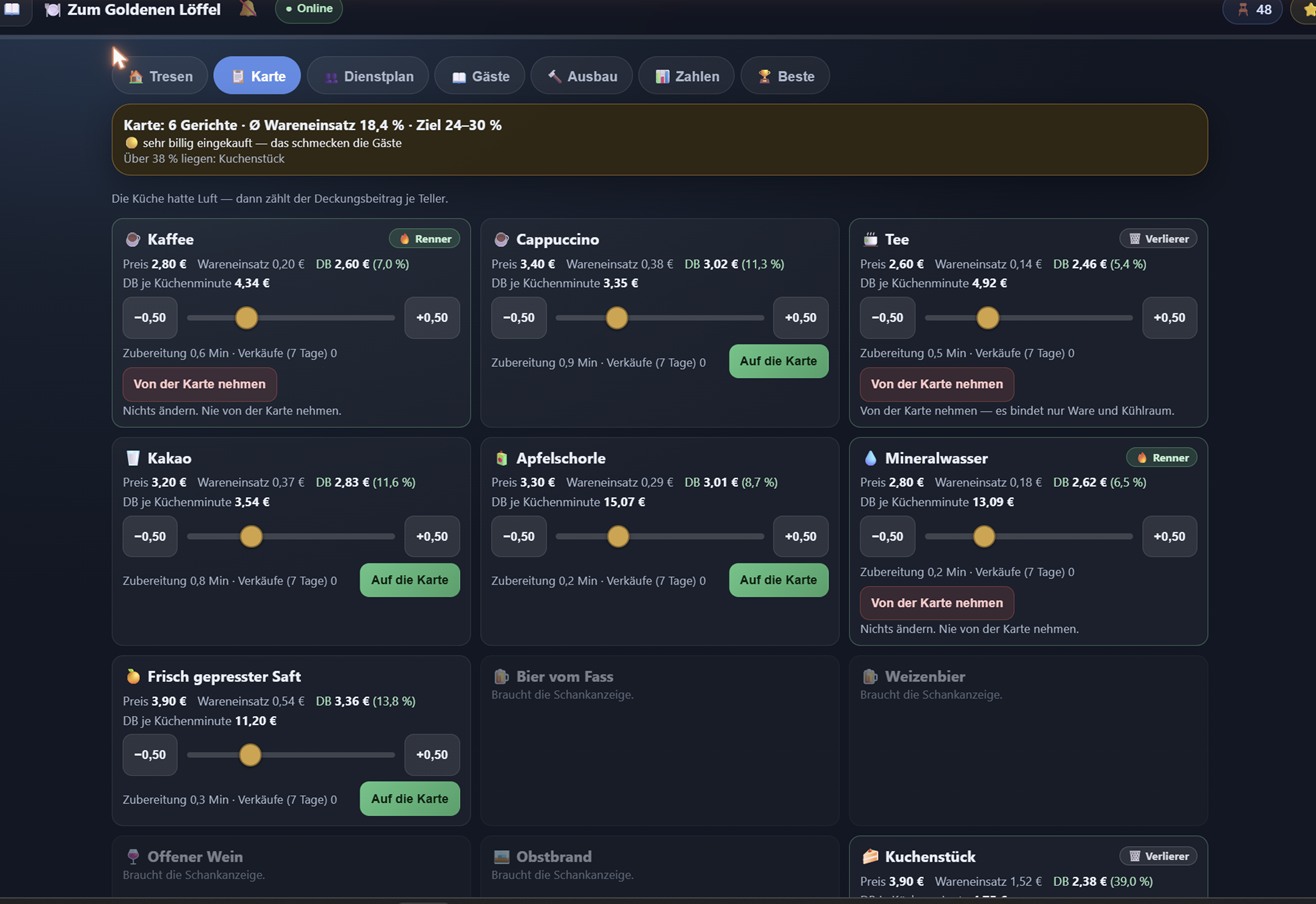
You do not sell guest by guest but through a menu you cost yourself: every dish has a food cost, a selling price, a preparation time and a popularity. Everything else follows from those four numbers. And above your menu you always see where you stand.
The game keeps running in real time while you are away — a trading day lasts two hours. But there is no bankruptcy, nothing spoils and no deadline runs away from you.
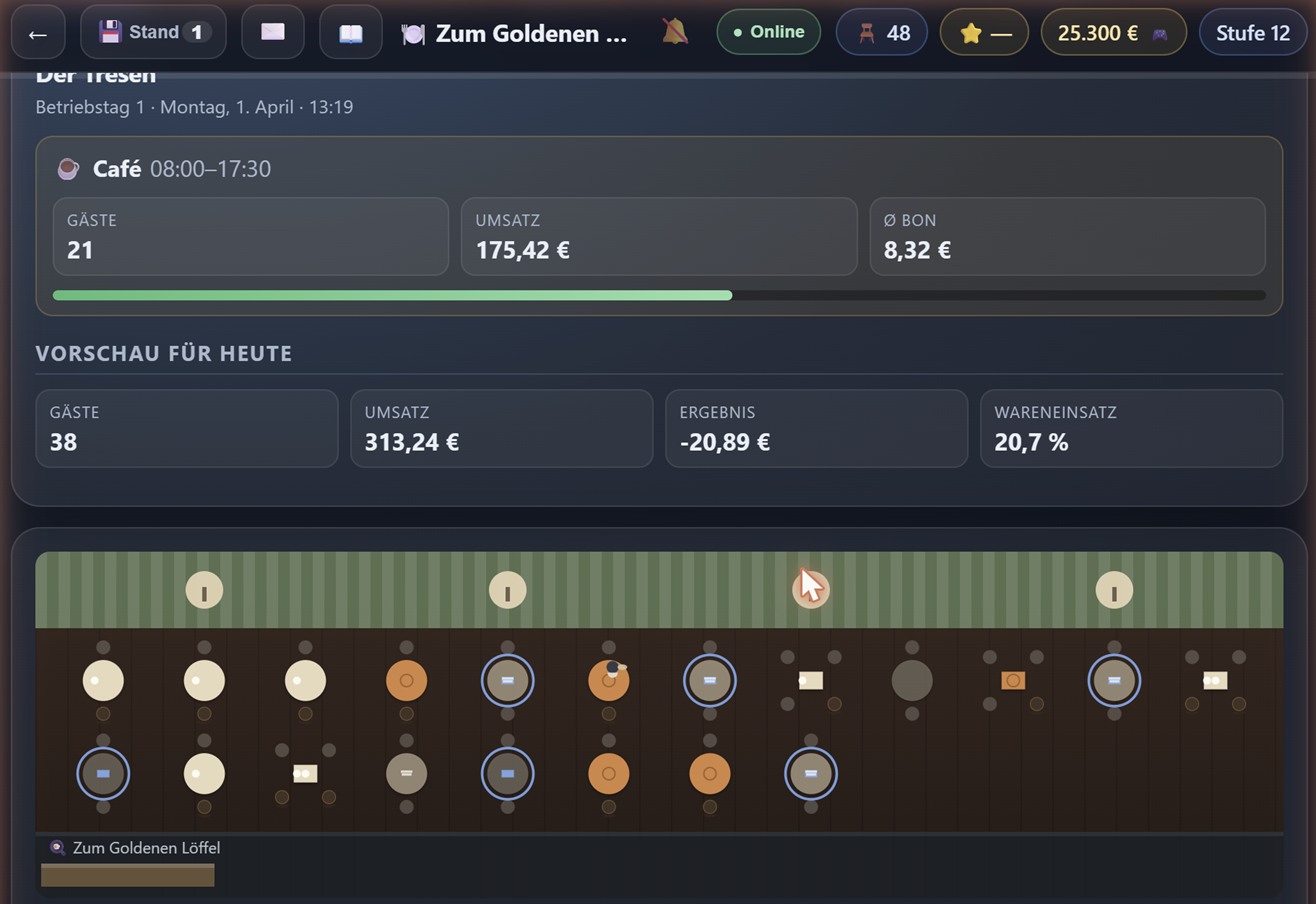
- Cost your own menu: food cost against selling price
- Real rent: base rent per m² or a share of revenue — the higher one counts
- Three services with their own character: café, lunch, evening
- From 8 to 130 seats — 20 expansion steps, nine of them pure quality
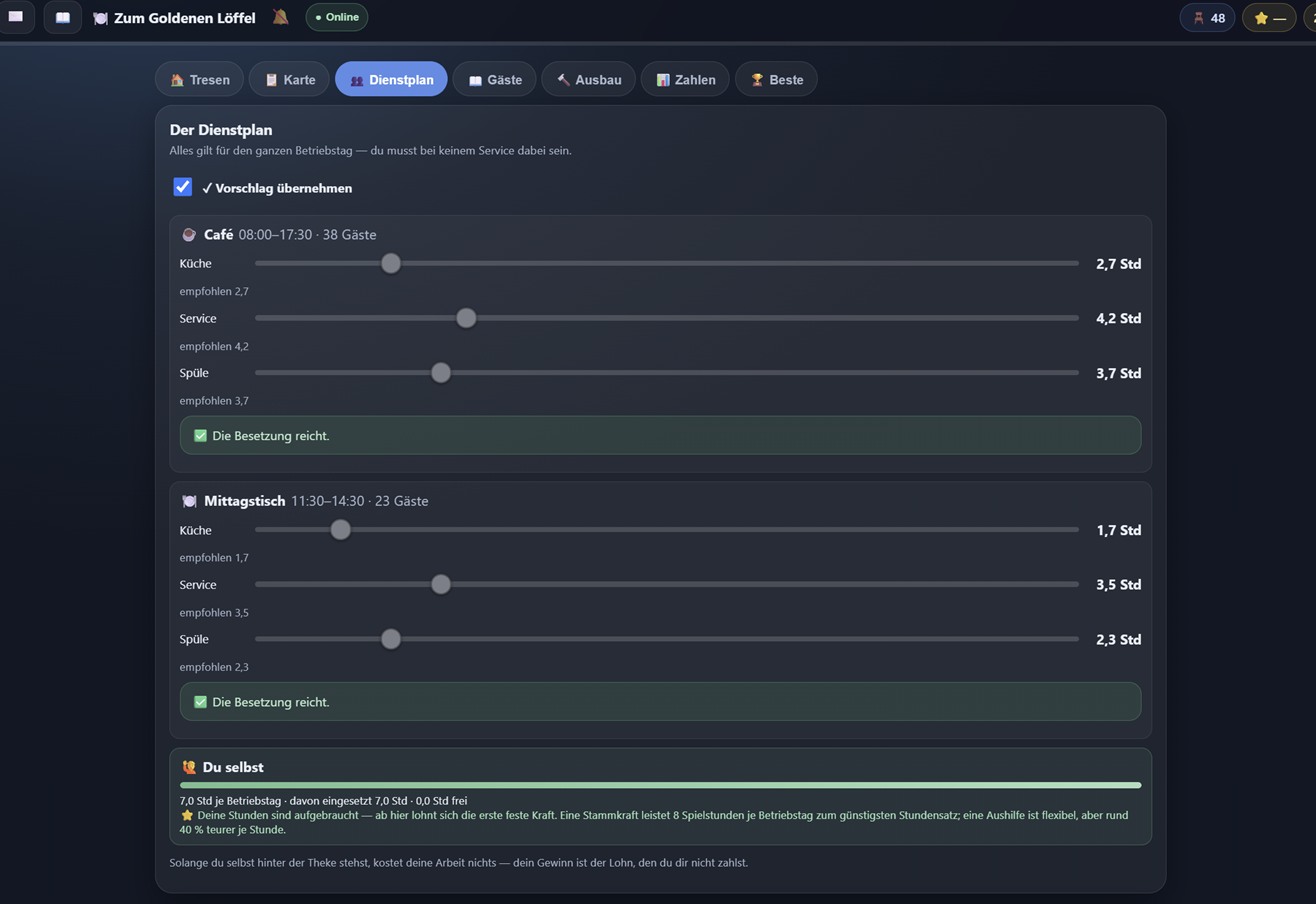
- Staff in shifts, with a real mini-job earnings limit
- Reviews built from six sub-scores, reservations, banquets
- Your house gets a name that you choose yourself
All you need is a nickname and a password. There is nothing to buy, nothing to pay out and no advertising. Works in any browser and on your phone.
Play for freeThe menu is the heart of the game
Every dish has four numbers: food cost, price, preparation time and popularity. From those the game works out three more that are always on screen — contribution margin, food cost ratio and contribution margin per kitchen minute.
The third one is the clever bit, and it is real trade craft: when the kitchen is the bottleneck, what counts is not the profit per plate but the profit per minute of kitchen time. The rump steak earns most per plate — and is still the worst dish for a busy lunch service.
Three services, three different businesses
They unlock one after the other — on the first day there is only coffee and cake. You win the café on food cost, the lunch service on throughput, and the evening on drinks and reservations.
The weekly rhythm is harder than in any other game in the arcade: the evening swings between a factor of 0.45 on Monday and 1.85 on Saturday. That is exactly why real landlords have a closing day — here it is a voluntary switch.
The rent runs whether anyone comes or not
The lease has two parts: a base rent of €15 per square metre and game month — and a share of revenue of 12 %. You always pay only the higher of the two, never both. That is the usual contract for catering premises.
At the start the base rent wins: while hardly anyone comes you pay it in full. Once the place runs it disappears behind the revenue share — and on a closing day it comes back, because with no revenue there is nothing to offset. That turns the choice of closing day into a real calculation.
And it grows with the house: every extension adds floor space, from the 45 m² shop unit to a good 200 m² at full build-out. How much rent an extension adds is shown in the offer before you buy.
Staff — the biggest cost block
As long as you stand behind the counter yourself, your work costs nothing: your profit is the wage you do not pay yourself. As you grow you have to buy that work — and the margin gets thin. That is the story of this game.
Casual staff cost by the hour, permanent staff by the trading day. And the mini-job limit is not decoration: 603 € a month is 43.4 hours per person.
Nothing spoils, nothing punishes you
There is no spoilage event in this game. Waste is already inside the food costs — and good housekeeping gives you up to five points of it back.
If you do not play for two days you come back to a state you can follow: the house ran on low power, and a report explains what happened, with cause and suggestion. There is no bankruptcy — an emergency brake winds the budgets down without creating debt.
On a phone
The game is built for a thumb: prices are slid, not typed, every dish is its own card instead of a table row, and there is not a single action with a countdown. Put the phone down in the middle of the evening service and you lose nothing.
Frequently asked questions
Does the restaurant game cost anything?
No. There are no paid items, no premium currency and no adverts. Everything is reachable with in-game money that you earn by playing.
Do I have to download anything?
No. It is a pure browser game: open the page and start. On a phone you can also add the arcade to your home screen as an app.
What happens if I do not play for a few days?
The house keeps running on low power. When you come back a page explains what happened. Nothing spoils, nobody resigns, and no debt is created.
How long is a day in the game?
A trading day is two real hours — twelve trading days a day. An evening service therefore lasts 25 minutes, so you can really watch it.
Is the restaurant connected to the other games?
Yes. All the businesses share one current account. Later the restaurant is meant to become the farm's biggest customer.